(spoilers for Kamiina Botan up to the anime's conclusion.)
Leading up to it's release, 上伊那ぼたん、酔へる姿は百合の花(Botan Kamiina Fully Blossoms When Drunk) was perhaps one of my most anticipated animes of 2026. While I am not an alcoholic (I hardly ever drink), the work has been one of my absolute favourite mangas for a number of years now. The work was adapted beautifuly, with each episode being handed to a different director, allowing for a wonderful explosion of many different styles and experimentation to take place, giving one of the most creatively impressive works across any genre in the past couple years.

Kamiina Botan isn't always the simplest work to understand, as many of it's characters communicate in rather cryptic, poetic manners, with various references, and often talking to each other in indirect manners. The only unifying aspect is how, in spite of all the obsfucation, the edges of their desire could be felt cutting into each other. The boundaries between the characters are made evident as they are always somewhat out of step with one another, leading to both confrontations and resolutions alike.
I have been a recent fan of Anne Carson's "Eros the Bittersweet" which dives into analyses of ancient greek attitudes with regards to love via poetry; one of the defining aspects in particular is of Sappho's glukupikron being interpreted as "Sweetbitter" by the author to draw attention to how eros can be thought of as a sequence of sweetness, then bitterness.
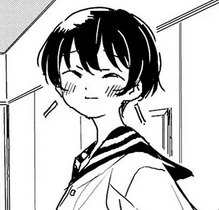
The titular Botan Kamiina, a first year student, is introduced as a girl who almost immediately forms a special connection with the RA, Ibuki Tonami, through their shared "burping" that stems from drinking a fizzy alcoholic beverage. There's an immediate setup that everyone understand here, with the space between the two serving as the spot where Eros lives, with Botan being an aggressive pursuer and Gujou Kanade, the dorm's smoking grad student, placed inbetween the two lovers as a hopeless third, creating the thrill of sweetness via the gap that Botan hesitates to cross.
Of course, Gujou never really had a chance at all, and is rejected fairly conclusively.

This space was never meant for her after all, so even as she is taken out of the picture, you can see the boundary between Botan and Ibuki solidify and become more present as Botan becomes closer.
As the work pulls away from this trio, and we widen the scene, we can see these edges start to materialize between the other pairings that slowly start to form amongst the group: Akane's love of music being something that is both the glue and divider between her and Yaeka, as well as the newly introduced Chin-lan who, as an outsider, cuts through this social space for Gujou at a speed that leaves her unsure in the wake of her rejection from Ibuki.

The love between each pairing is there; it floods the spaces between each character, but there is this almost self correcting mechanism to maintain the tiniest bit of distance so that their desire can be maintained. Akane and Yaeka are somewhat sidelined, as their conflict takes place beyond the confines of the anime, but we can see it perhaps the clearest; with Yaeka wanting to support, but Akane's love for music pulls her in two different directions. She doesn't want to upset Yaeka, but at once she wishes she could be "consumed" by her love for music.

Of course, this expression is communicated clearly to Botan too, since, like any other lover, she wouldn't want anything else(as Aristophanes expresses via Hephaistos in Plato's Symposium). Unfortunately, this space persists between them due to the lack of a mutual understanding, as Botan still feels uncertain on Ibuki's feelings despite having gone past the point of friendship with her already, questioning if Ibuki really enjoys their time together.

At the same time, as Gujou becomes further and further away from Ibuki, the space becoming a chasm that is unable to be crossed, Gujou is faced with a dilemma of whether or not she can actually let go of her desire for Ibuki and take Chin-lan's hand. Slowly, we can see the boundary between Gujou and Ibuki become a wall that is at once plain to everyone to see, and something that completely walls off the possibility of romance between the two as we see how Ibuki does, in fact, love Gujou, just in the realm of platonic.

Meanwhile, Gujou does enjoy her time with Chin-lan, but is confused.

A reoccuring aspect of her character, often speaking in metaphor or references to the works that she loves. It is in here, through her use of metaphors to be indirect (her talking about Taiwanese movies to express her interest in understanding Chin-lan for example), and her naturally avoidant nature that we can see the line between the two characters start to form. As Chin-lan has no reservations at all, being open about her love, and steadfast in her commitment to it.

Of course, in a sense, Gujou has always been particularly difficult (with her movie recommendation to a movie newcomer like Botan being Bergman's wild strawberries), but for anyone that understands her you can feel out the desire that scared of actualizing. This is, of course, something that Chin-lan is well aware of.


There is a manner of pessimism, that you could see in how Anne Carson interprets the Greek's view of love; as desire is defined by lack, so at the point of realization, when it is actualized, it disappears. However, I'm not certain that the work holds such an attitude, and there's a sort of counter to it as we see the characters grow in their relationships and bonds with each other. I'm precluding non-anime events, so, unfortunately, I cannot speak on Akane and Yaeka as their developments are both difficult, and something that has yet to come.
Borrowing from Kierkegaard, there is an "aesthetic validity of marriage," where it is a commitment, a vow that is a "glorification of [desire]," and how love can survive even past the point of consummation. While the marriage is metaphorical, the actual point of interest lies in how the characters step past the line and affirm a commitment to each other. Gujou and Kanade only start to approach this line, as we see them exchange gifts at a bookstore.

Chin-lan gifts Gujou a poetry collection from Taiwanese poets, an offering with metaphorical weight of wanting to be understood that Gujou surely would understand as Chin-lan playfully engages with Gujou's attitude, and Gujou gifts Chin-lan a collection of photo postcards for her to write about herself so that Gujou could better get to know Chin-lan; a response in step with Chin-lan's that begins to affirm their relationship, even if it isn't explicitly defined quite yet.

On the other hand, with Botan and Ibuki we can see how Botan's anxieties start to consume her, as she wants to know what Ibuki wants; it is here that we return to the edge, and understand most poignantly how her bitterness pokes a slight head inside of her as she doesn't get the answers to the questions that she wants about Ibuki's feelings.

This lack of possessing what she wants is where eros is created, this boundary is self-reinforcing until Botan is spurred to action. We see her loneliness crystallized, as the wintry weather falls and she mulls over her own thoughts.

In stark contrast from her ambiguous, yet clearly self assured self when the space between them was a bit further, as she beckoned Ibuki to follow her into the depths with a simple "trust me." Despite the two being so different, Gujou and Botan both speak in wordplay, and, as Anne Carson notes, their language flouts the edges of things in the same manner that Eros does. However, while Gujou, thankfully, has Chin-lan to cut through the veils, Botan lacks that at that moment when she feels lost, and must cross the bridge herself.
And so, she tries to cross the rubicon alone, only to get rebuked by Ibuki in what feels like a rejection.

It is here, however, that we see how the two of them reaffirm their commitment to each other, with Ibuki having gotten them the earrings that Botan was looking for, and later, the two of them signing a reservation for a liquor that would take five years of waiting to be able to savour. As Kierkegaard notes, "conjugal love has its foe in time, its triumph in time, its eternity in time," as we see how their commitment to each other is reified in this certificate. When Botan worries that they may not be together anymore in five years, Ibuki replies, "Let's make sure we're not."

Some readings:
Currently listening to: MOONSHINE - by Bar CircoWishing you well,
Cecilia